No. Ivermectin does not kill Toxoplasma gondii or treat toxoplasmosis. Ivermectin is an anthelmintic — a drug built to paralyze and kill worms — and toxoplasmosis is caused by a single-celled protozoan, a completely different type of organism with a different biology. Confirmed toxoplasmosis treatment relies on antiprotozoal drugs such as pyrimethamine-sulfadiazine, clindamycin, or azithromycin, prescribed and monitored by a physician.
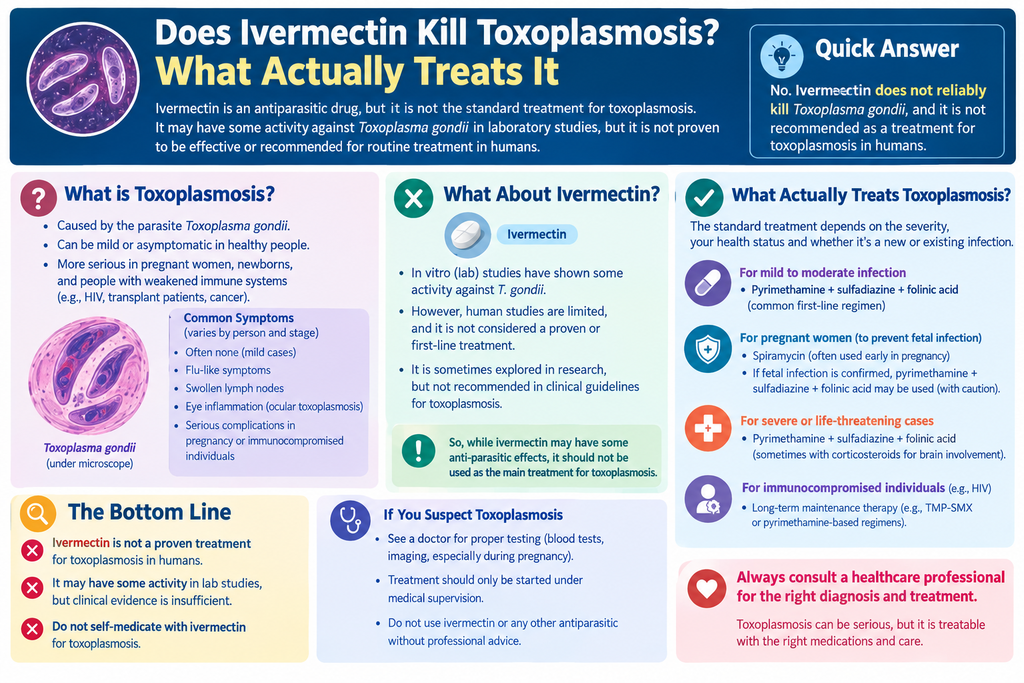
That one distinction — worms versus protozoa — is the answer to almost every question in this article. Ivermectin, fenbendazole, and most over-the-counter dewormers work on parasites with nerve and muscle structures that pyrimethamine, sulfadiazine, and other antiprotozoals don’t touch, and vice versa. Once you see which category a drug and a parasite each belong to, the rest of this falls into place.
What toxoplasmosis is, and why it needs protozoa-specific treatment
Toxoplasma gondii is a single-celled protozoan parasite, not a worm. It spreads to humans through undercooked or contaminated meat, unwashed produce grown in contaminated soil, contaminated water, or contact with cat feces containing the parasite’s oocysts (its environmentally resistant egg-like stage). Most healthy adults who get infected have no symptoms or a mild, flu-like illness that resolves without treatment. The infection becomes serious in three groups: babies infected before birth (congenital toxoplasmosis), people with weakened immune systems (where it can cause encephalitis), and, less commonly, people who develop eye involvement (ocular toxoplasmosis).
Because it’s a protozoan rather than a worm, treating it requires drugs built for protozoa — the same category used against malaria and other single-celled parasites — not the anthelmintics used against roundworms and tapeworms. That mismatch is also why a specific cluster of search questions keeps surfacing: people reach for a dewormer they already have on hand and ask whether it will work on an infection it was never designed to treat.
Does ivermectin kill Toxoplasma gondii?
Ivermectin works by binding to glutamate-gated chloride channels found in the nerve and muscle cells of invertebrates like roundworms and certain insects and mites. This causes paralysis and death in the parasite. Protozoa like Toxoplasma gondii don’t have this type of channel, so ivermectin has no direct mechanism to act on it. No regulatory body — not the FDA, not any veterinary or international health authority — has approved ivermectin for toxoplasmosis in humans or animals.
There is early laboratory research worth knowing about, mainly because it’s likely to come up in searches and deserves an honest read rather than a dismissal. A 2023 study in immunocompromised mice found that ivermectin reduced the number of T. gondii brain cysts by roughly 69% and improved brain tissue changes associated with the infection. That sounds promising, but the study’s own authors were cautious about it: ivermectin generally penetrates the blood-brain barrier poorly, they recommended using it “with caution” in this context, and they called for further studies with adjusted dosing or drug combinations before drawing any clinical conclusions. This is preclinical animal research, not evidence that ivermectin treats toxoplasmosis in people — and it shouldn’t be read as a shortcut around physician-directed treatment.
Does ivermectin kill protozoa in general?
Ivermectin’s approved spectrum covers nematodes (roundworms) and a handful of ectoparasites like mites and lice. It has no established clinical activity against the protozoa responsible for toxoplasmosis, babesiosis, Chagas disease, or trichomoniasis. A few of these have their own laboratory research worth a quick look:
Does ivermectin kill babesia?
Laboratory studies have shown some inhibition of Babesia and Theileria parasite growth in vitro, but this hasn’t translated into a clinical treatment. Babesiosis is currently treated with atovaquone plus azithromycin, or clindamycin plus quinine in more severe cases.
Does ivermectin kill Trypanosoma cruzi (the parasite behind Chagas disease)?
Research is actively exploring ivermectin’s broader antiparasitic potential here, including effects on related trypanosomatids, but benznidazole and nifurtimox remain the only approved treatments for Chagas disease.
Can ivermectin treat trichomoniasis?
No. Trichomoniasis is a protozoal sexually transmitted infection, and the standard treatment is metronidazole or tinidazole — not ivermectin.
What ivermectin actually treats
It’s worth being specific about where ivermectin does work, since that’s the flip side of the same question.
Can ivermectin kill roundworms?
Yes — this is one of ivermectin’s core, well-established uses. It’s effective against a number of roundworm species in both humans and animals, including conditions like strongyloidiasis and onchocerciasis (river blindness).
Can ivermectin kill tapeworms?
No. Tapeworms (cestodes) have a fundamentally different structure and biology from roundworms, and ivermectin’s mechanism doesn’t extend to them. Praziquantel is the standard treatment for tapeworm infections.
Does ivermectin kill coccidiosis?
No. Coccidiosis is caused by Eimeria or Isospora species — protozoa, not worms — and is treated with drugs like amprolium, sulfa-based medications, or toltrazuril.
Does ivermectin kill trichinosis?
This one has a genuine nuance: Trichinella, the parasite behind trichinosis, actually is a nematode (roundworm), the same broad group ivermectin usually targets. Even so, albendazole and mebendazole are the established first-line treatments for trichinosis, and ivermectin isn’t part of standard clinical care for it.
What actually treats toxoplasmosis
For anyone diagnosed with toxoplasmosis that requires treatment, the standard approach looks like this:
The first-line regimen combines pyrimethamine and sulfadiazine, along with leucovorin (folinic acid) to offset the bone marrow suppression pyrimethamine can cause. When a patient can’t tolerate this combination — often due to sulfa allergy — physicians turn to alternatives such as clindamycin plus pyrimethamine, or azithromycin plus pyrimethamine.
Does azithromycin treat toxoplasmosis?
Yes, as part of an alternative combination regimen, particularly for patients with sulfa sensitivities or in specific pregnancy protocols. It’s generally used alongside pyrimethamine rather than as a standalone treatment.
Does amoxicillin treat toxoplasmosis?
No. Amoxicillin is a beta-lactam antibiotic that works against bacteria by disrupting cell wall synthesis — a mechanism protozoa don’t rely on, so it has no established role in treating toxoplasmosis.
Exact drug choice, dosing, and treatment duration depend on who’s being treated: congenital cases in infants, ocular toxoplasmosis, or infection in someone who is immunocompromised all follow different protocols, and all require a physician’s direction and monitoring.
Can disinfectants, heat, or dewormers destroy Toxoplasma outside the body?
Since so many of these searches are really about prevention and cleaning rather than treatment, it’s worth addressing that side directly.
Does boiling kill toxoplasmosis?
Yes. Heat is one of the most reliable ways to inactivate Toxoplasma tissue cysts and oocysts, which is why cooking meat to a safe internal temperature is a core prevention recommendation.
Does alcohol kill toxoplasmosis?
Not reliably. The evidence for alcohol-based disinfectants effectively inactivating Toxoplasma oocysts is weak, and alcohol shouldn’t be relied on as a decontamination method for this parasite.
Does bleach kill toxoplasmosis?
Not with confidence. The oocyst wall is unusually resistant to environmental stress. Research examining household bleach’s effect on the oocyst wall found it altered the structure without reliably destroying it, so bleach isn’t a guaranteed way to eliminate Toxoplasma from a contaminated surface.
Does a dewormer kill toxoplasmosis?
No. This is really the same question as the ivermectin one, generalized: over-the-counter dewormers — ivermectin, fenbendazole, albendazole, praziquantel — are built to act on worms. None of them have an established mechanism against the protozoan that causes toxoplasmosis.
Does fenbendazole kill Toxoplasma gondii?
Fenbendazole is a benzimidazole anthelmintic, and it runs into the same category mismatch as ivermectin: it’s built to disrupt worm biology, not protozoal biology. Some early in vitro screening studies have tested fenbendazole’s activity against Toxoplasma, but there’s no established clinical evidence or approved use supporting it as a treatment. As with ivermectin, it shouldn’t be substituted for physician-prescribed antiprotozoal treatment.
Frequently asked questions
No. Ivermectin has no established activity against Toxoplasma gondii. It’s an anthelmintic that targets roundworms and certain external parasites, not protozoa. Confirmed treatment for toxoplasmosis uses antiprotozoal drugs like pyrimethamine-sulfadiazine, clindamycin, or azithromycin.
Yes. This is one of ivermectin’s primary approved uses, effective against a range of roundworm species in humans and animals, including Strongyloides and Onchocerca.
No. Tapeworms are structurally different from roundworms, and ivermectin’s mechanism doesn’t act on them. Praziquantel is the standard tapeworm treatment.
No. Coccidiosis is caused by protozoa (Eimeria or Isospora), which ivermectin doesn’t target. Amprolium, sulfa drugs, and toltrazuril are used instead.
No, not as an approved use. Ivermectin’s spectrum is limited to nematodes and select ectoparasites, not the broader category of protozoal parasites.
Not as an established clinical treatment. In vitro studies show some growth inhibition, but atovaquone-azithromycin or clindamycin-quinine remain the standard treatments for babesiosis.
No. Research is exploring ivermectin’s broader antiparasitic potential, but benznidazole and nifurtimox are the only approved treatments for Chagas disease.
No. Trichomoniasis is a protozoal infection treated with metronidazole or tinidazole, not ivermectin.
Not as standard care. Although Trichinella is technically a nematode, albendazole and mebendazole are the established first-line treatments rather than ivermectin.
Yes, as part of an alternative combination regimen (typically with pyrimethamine), used for patients who can’t tolerate sulfa-based drugs or in specific pregnancy protocols.
No. Amoxicillin is an antibacterial with no established activity against Toxoplasma gondii.
Not established for clinical use. Early lab research has tested this, but there’s no approved treatment based on it.
Yes. Heat reliably inactivates Toxoplasma in meat, which is why cooking to a safe internal temperature is a key prevention step.
Not reliably. Evidence supporting alcohol-based disinfectants against Toxoplasma oocysts is weak.
Not with confidence. Toxoplasma oocysts have an unusually resistant wall that standard bleach exposure doesn’t reliably destroy.
No. Dewormers are built to act on worms, and toxoplasmosis is caused by a protozoan — a different class of parasite entirely.