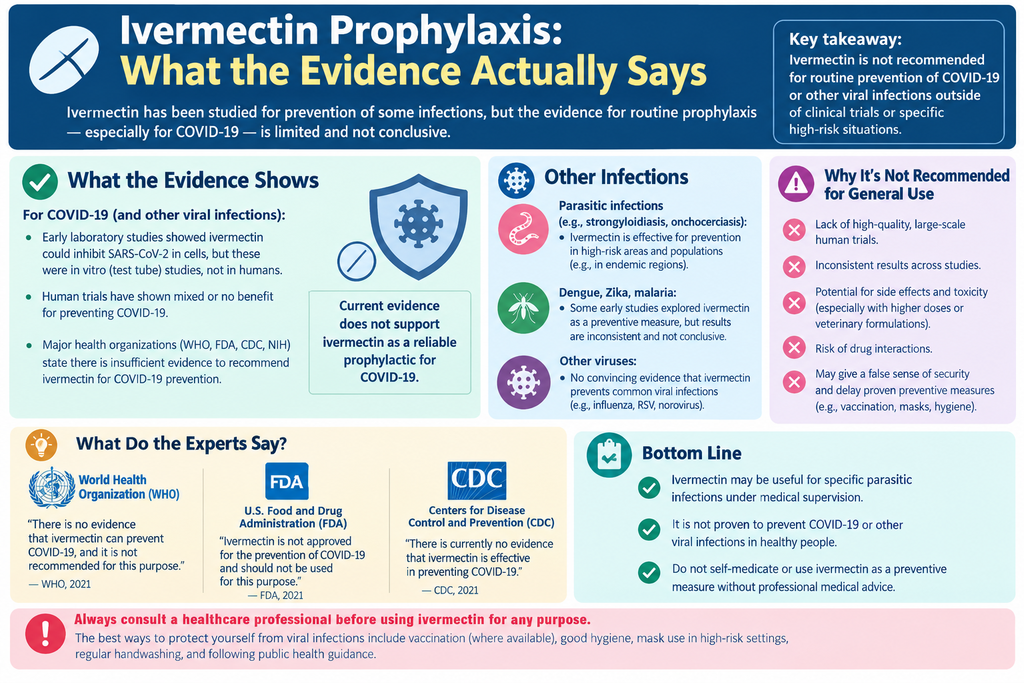
There is no FDA-approved, CDC-recommended, or clinically established dose of ivermectin for preventing an infection you don’t yet have. Ivermectin’s approved uses are for treating specific parasitic infections and skin conditions — not for regular or weekly use as a preventive measure. Much of the interest behind terms like “ivermectin prophylaxis” and “prophylactic dosage” traces back to wellness and social-media claims that outran the clinical evidence. Here’s what’s actually approved, what’s been studied, and what isn’t.
What does “prophylactic” mean for a drug like ivermectin?
Prophylaxis means using a drug to prevent a disease before it occurs, rather than to treat an existing one — the same logic behind malaria chemoprophylaxis for travelers or PrEP for HIV prevention. Ivermectin’s FDA-approved uses are all treatment-based: strongyloidiasis, onchocerciasis, scabies, head lice, and topical rosacea. It has no FDA-approved or clinically established prophylactic use against viral illnesses like COVID-19, flu, or RSV, so “ivermectin prophylaxis” describes a use the drug was never approved for, not a recognized category of treatment.
What is ivermectin actually approved to treat?
Ivermectin is an antiparasitic in the avermectin class, discovered by William C. Campbell and Satoshi Ōmura (work that earned the 2015 Nobel Prize in Physiology or Medicine) and developed by Merck. Its approved, treatment-based uses include:
- Strongyloidiasis — an intestinal roundworm infection
- Onchocerciasis (river blindness) — a parasitic worm infection spread by blackflies
- Scabies — oral or topical, for mite infestations
- Head lice — topical lotion
- Rosacea — a topical cream (brand name Soolantra) for inflammatory lesions
In every approved use, dosing is weight-based, prescribed by a doctor, and given as a single dose or short course — not a recurring, supplement-like regimen. This is a meaningfully different pattern from taking a drug “regularly” or “weekly” as a precaution.
Is there an approved or safe prophylactic dose?
No. The FDA, CDC, and WHO have not established or endorsed a prophylactic dosing schedule for ivermectin against any viral illness. Dosing charts and “prevention protocols” circulating online — including one promoted by the nonprofit FLCCC as an ongoing COVID/flu/RSV prevention regimen — are not endorsed by any major public health authority. Existing dosing information applies only to ivermectin’s approved indications, is short-course and doctor-prescribed, and doesn’t transfer safely to open-ended preventive use.
What benefits are claimed for regular or weekly use — and what does the evidence show?
Regular, unsupervised ivermectin use hasn’t been shown to provide general health benefits. During the COVID-19 pandemic, ivermectin was widely promoted for prevention and treatment, prompting a joint AMA, APhA, and ASHP statement urging clinicians to stop prescribing it for that purpose, and a CDC health advisory documenting a rapid rise in prescriptions alongside reports of severe illness. Claims about broader “immune support” or anti-aging benefits from taking ivermectin on a schedule are not backed by clinical trial evidence — they largely trace back to the same online communities that promoted its use during the pandemic.
Does ivermectin support prostate health?
Laboratory and animal studies have found that ivermectin and related compounds affect cell-signaling pathways implicated in prostate cancer — for example, effects on FOXA1 and Ku70/Ku80, HSP27 inhibition, and a derivative’s action on β-catenin signaling. This research is preclinical: it’s been conducted in cell lines and animal models, not in human clinical trials. It hasn’t been tested for, and isn’t an approved or established treatment for, prostate cancer, benign prostatic hyperplasia, or general prostate health. Early lab findings are a reason for future research, not a basis for self-treatment.
What are the real risks of unsupervised use?
Taking ivermectin outside its approved indications and dosing carries real toxicity risk. Reported effects range from nausea, vomiting, and low blood pressure to confusion, seizures, and, in severe cases, coma, according to data compiled by the American College of Medical Toxicology. Poison control centers reported a sharp surge in ivermectin-related calls during periods of high unsupervised use, and the FDA has specifically warned against taking animal-formulated ivermectin — concentrated for livestock, not people — which has caused documented poisonings.
What to do instead
If you’re concerned about a specific infection risk, a doctor can advise on prevention methods actually validated for that purpose — vaccination, appropriate prophylaxis for a documented exposure, or relevant screening and diagnostic testing. If your interest is prostate health specifically, standard screening (PSA testing, physical exam) and an in-person evaluation remain the validated path, not an unapproved drug regimen.
FAQ
They’re chemically related but formulated at very different concentrations for different species. The FDA has specifically warned against taking animal-formulated ivermectin, which has caused documented poisonings in people.
Reported toxicity includes nausea, vomiting, low blood pressure, confusion, seizures, and in severe cases coma. Poison control centers saw a sharp rise in ivermectin-related calls during periods of unsupervised preventive use.
Taking ivermectin as a precaution against an infection you don’t have, or a virus it isn’t approved for, isn’t supported by current evidence or regulatory guidance. If you’re concerned about a specific risk, a doctor can advise on tests and preventive options actually validated for that purpose.