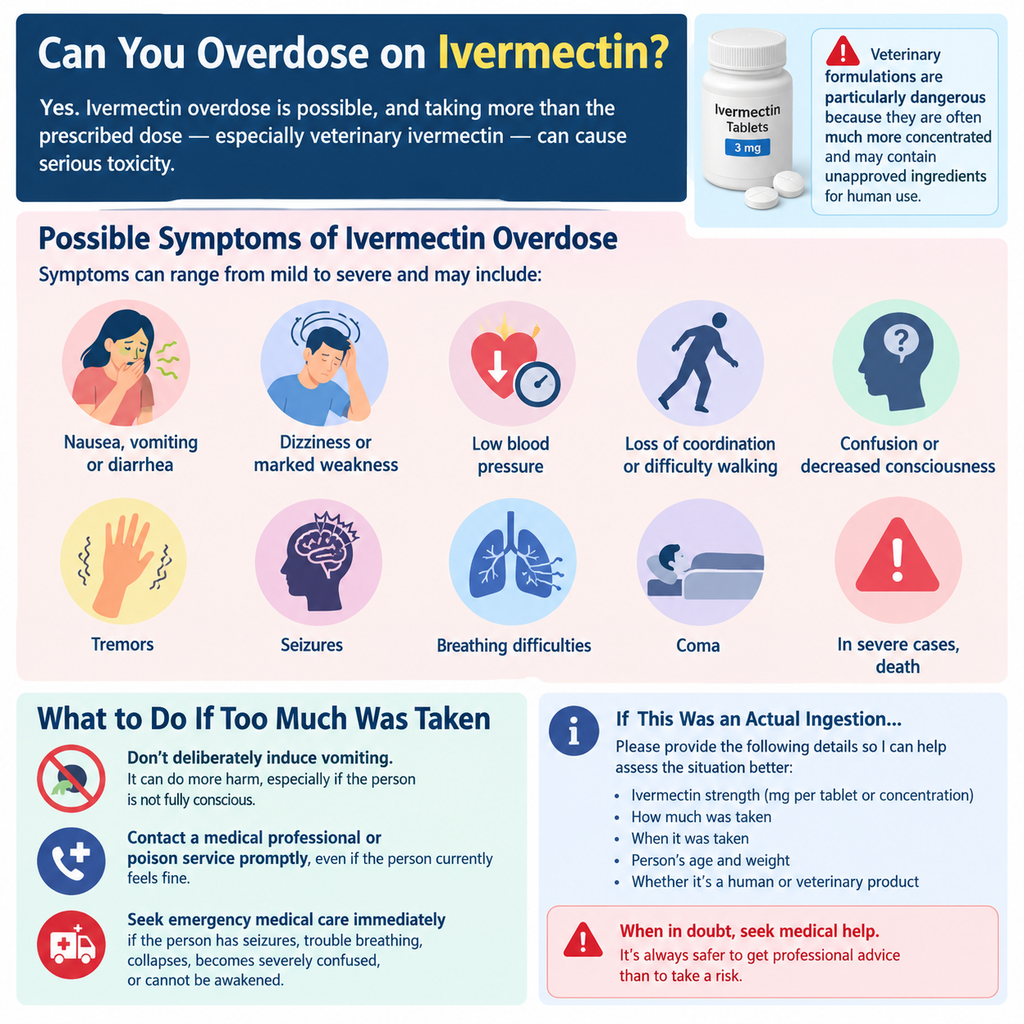
Yes, ivermectin can cause a dangerous overdose in humans, especially at doses well above the FDA-approved range of 150–200 mcg/kg or when veterinary (animal) formulations are used instead of human tablets. An overdose can cause symptoms ranging from nausea and dizziness to confusion, seizures, and coma in severe cases.
This article is for informational purposes only and is not a substitute for professional medical advice. If you suspect an overdose, seek emergency medical care right away.
Can you overdose on ivermectin?
Yes, it’s possible to overdose on ivermectin, though it’s uncommon when the medication is taken exactly as prescribed. Ivermectin is FDA-approved for specific human uses, including strongyloidiasis (an intestinal parasite) and onchocerciasis (river blindness), typically dosed at 150–200 mcg/kg (0.15–0.2 mg/kg) as a single dose, with some regimens allowing up to 0.4 mg/kg per day.
Overdose risk rises sharply once someone strays from that approved dose or formulation. Research has found that doses up to roughly 10 times the approved maximum haven’t shown clear signs of toxicity in some studies — but real-world poisoning cases have occurred at 10 to 100 times the normal human dose, particularly when people take veterinary or animal formulations. Products made for livestock (cattle, horses) are far more concentrated and are dosed for animal body weight, not human use, which makes accidental overdose much more likely if someone takes them.
The most common real-world driver of ivermectin overdose is self-medication — for example, people taking ivermectin without a prescription to try to prevent or treat COVID-19, treating parasites without medical guidance, or taking multiple doses too close together. Poison control centers in the US reported a sharp increase in ivermectin-related calls during periods when unsupervised, off-label use was more common, underscoring that this risk is real rather than theoretical.
Ivermectin toxicity in humans: symptoms by severity
Symptoms of ivermectin toxicity can start within one to five hours of ingestion, according to published case reports, and range from mild to life-threatening depending on the dose and formulation involved.
Mild to moderate symptoms
At lower overdose levels, symptoms tend to be uncomfortable but not immediately dangerous:
- Nausea, vomiting, diarrhea, and abdominal pain
- Dizziness and headache
- Rash or itching (pruritus)
- Mild tachycardia (a faster-than-normal heartbeat)
- Drowsiness
Severe or emergency symptoms
At higher doses, or with more concentrated veterinary formulations, ivermectin toxicity can affect the nervous system and other vital functions:
- Confusion and disorientation
- Hallucinations
- Tremors and loss of coordination (ataxia)
- Seizures
- Decreased consciousness or coma
- Low blood pressure (hypotension)
- Slowed or difficult breathing (respiratory failure)
Deaths from ivermectin overdose are rare but have been reported, mostly in cases involving concentrated veterinary formulations or very high doses. It’s also worth noting that ivermectin can intensify the sedating effects of other central nervous system depressants, such as benzodiazepines, barbiturates, and alcohol — combining these substances raises the risk of severe symptoms even at lower ivermectin doses.
Is ivermectin dangerous for humans to take?
On its own, ivermectin taken at the correct, medically supervised dose is considered safe — it’s FDA-approved and has been used for decades to treat conditions like strongyloidiasis, onchocerciasis, and scabies. At these prescribed doses, most people experience only mild side effects, if any, such as nausea, dizziness, or itching.
The danger comes from how the medication is used, not the medication itself. Risk increases significantly when ivermectin is:
- Taken without medical supervision or a prescription
- Sourced as a veterinary or animal formulation rather than a human product
- Combined with other medications that depress the central nervous system
- Taken by someone with pre-existing liver conditions or other relevant health issues, without medical guidance
In short: ivermectin is not inherently dangerous when used as intended, but self-directed or unsupervised use — especially with non-human formulations — substantially raises the risk of serious adverse effects.
What to do if you suspect an ivermectin overdose
If you think you or someone else has taken too much ivermectin, don’t wait to see if symptoms improve on their own. Take these steps:
- Call Poison Control right away. In the US, the number is 1-800-222-1222, available 24/7. If you’re outside the US, contact your local emergency or poison control service.
- Seek emergency medical care immediately for any neurological symptoms — confusion, seizures, difficulty staying awake — or trouble breathing.
- Don’t try to induce vomiting unless a medical professional specifically tells you to.
- Bring the packaging or bottle to the hospital or when speaking with poison control, so providers can identify the exact product, strength, and whether it’s a human or veterinary formulation.
There’s no specific antidote for ivermectin overdose. Treatment is supportive and may include IV fluids, activated charcoal if given soon after ingestion, close monitoring of heart rate and blood pressure, and respiratory support if breathing is affected. Most people who receive prompt medical care recover, but severe cases require hospitalization and close observation.
Can you take expired ivermectin?
Expired ivermectin is a different safety question from overdose — it’s about reduced effectiveness rather than added danger. Most oral medications, tablets included, often retain meaningful potency for some time past their printed expiration date if they’ve been stored properly (in a cool, dry place, in their original packaging). This is part of why the FDA’s Shelf Life Extension Program exists, and why manufacturers tend to set conservative expiration dates.
That said, taking expired medication isn’t something the FDA or manufacturers officially recommend. As a medication ages past its expiration date, its potency can decline, which may make it less effective at treating the condition it’s meant for — potentially leaving an infection or parasite undertreated. Liquid, injectable, or reconstituted formulations degrade faster than tablets and carry more risk once expired.
Taking expired ivermectin isn’t typically an overdose risk in the way taking too much fresh medication is. But it’s also not a reason to take extra ivermectin on the assumption that an expired dose is “safe” to combine with a fresh one — dosing should still follow the amount prescribed. If you’re unsure whether your ivermectin is still good to use, check with a pharmacist, and dispose of expired medication properly — through an FDA drug take-back program rather than the household trash or toilet.
FAQs
Yes. While overdose is uncommon at properly prescribed doses, taking too much ivermectin — especially in veterinary or highly concentrated formulations — can cause symptoms ranging from nausea and dizziness to seizures and coma. See “Can you overdose on ivermectin?” above for more detail.
The FDA-approved dose for human use is 150–200 mcg/kg (0.15–0.2 mg/kg) as a single dose for most approved indications. Toxicity has typically been documented at several times that amount — often at doses around 2 mg/kg and higher. Veterinary formulations are far more concentrated than human tablets, which makes them especially risky if taken by mistake or intentionally.
Mild symptoms include nausea, vomiting, diarrhea, dizziness, headache, rash, and a faster heartbeat. Severe symptoms include confusion, hallucinations, tremors, seizures, decreased consciousness or coma, low blood pressure, and breathing difficulty. See the toxicity section above for the full breakdown by severity.
It’s rare when ivermectin is taken at prescribed, medically supervised doses. The risk rises mainly with veterinary product misuse or intentional overdose. Poison control centers saw a notable increase in ivermectin-related calls during periods of unsupervised, off-label use, which shows the risk is real when the medication isn’t used as directed.
Overdose is uncommon when ivermectin is taken at the approved therapeutic dose under medical supervision for these conditions. The risk comes mainly from repeated or excessive self-dosing without medical guidance, not from a single correctly prescribed dose.
At the correct, medically supervised dose, ivermectin is considered safe and is FDA-approved for specific uses. It becomes dangerous when it’s misused, self-prescribed, or taken as a veterinary formulation rather than a human one.
Call poison control (1-800-222-1222 in the US) or seek emergency medical care immediately — don’t wait for symptoms to worsen. Bring the packaging with you so healthcare providers know exactly what was taken and at what strength.
Expired ivermectin may lose potency over time, and taking it isn’t officially recommended. It’s generally not an overdose or safety risk on its own, but reduced effectiveness means it may not fully treat the condition it’s meant for. Check with a pharmacist if you’re unsure.
Common, mild adverse effects include nausea, dizziness, and itching. Rare but serious reactions — usually associated with overdose or misuse — include confusion, seizures, and breathing difficulty. These are distinct from the effects of a properly dosed, medically supervised treatment.