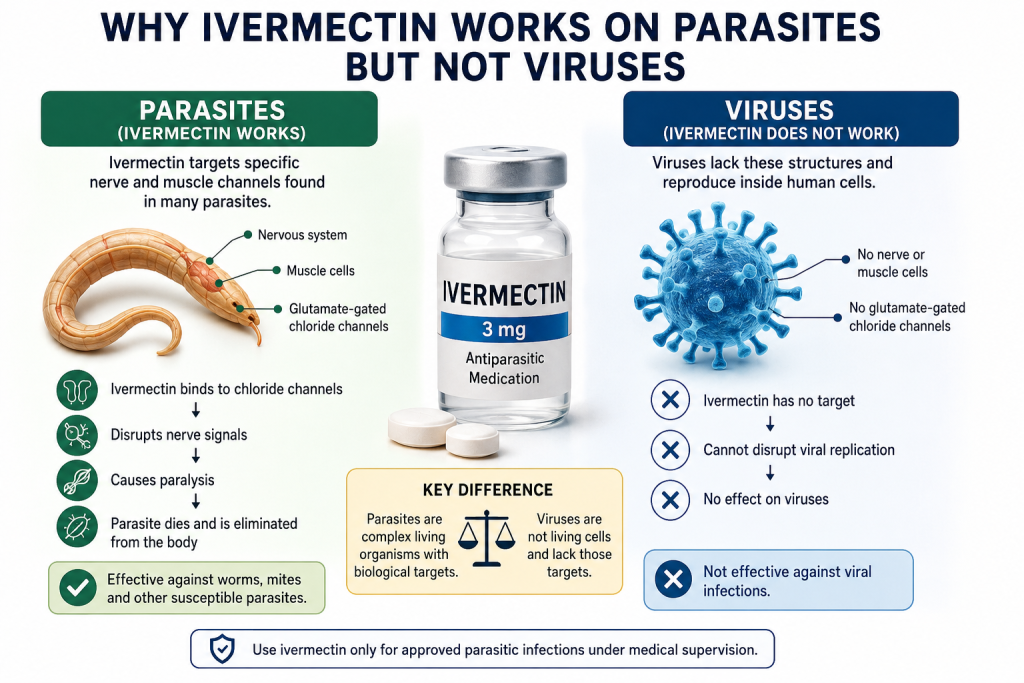
Ivermectin works on parasites because it targets specific nerve and muscle channels found in many parasites, causing paralysis and death. Viruses do not have these structures and instead reproduce inside human cells, making ivermectin ineffective against viral infections. Current scientific evidence supports ivermectin for certain parasitic diseases but does not show proven benefits for treating viral infections.
Quick Facts About Ivermectin
| Fact | Explanation |
|---|---|
| Drug Type | Antiparasitic medication |
| Primary Use | Treats parasitic infections |
| Effective Against | Certain worms, mites, and parasites |
| Effective Against Viruses | No proven clinical benefit |
| Approved Medical Use | Specific parasitic diseases |
| Mechanism of Action | Targets parasite nerve and muscle function |
What Is Ivermectin?
Ivermectin is a prescription medication used to treat several parasitic infections in humans. It belongs to a class of drugs known as antiparasitic medications and has been widely used for decades to control diseases caused by worms and other parasites.
Healthcare providers prescribe ivermectin because it effectively targets specific biological systems found in parasites while generally sparing human cells. This selective action makes it an important treatment option for several tropical and parasitic diseases.
What Is Ivermectin Used For?
Ivermectin is commonly used to treat:
- Strongyloidiasis (intestinal roundworm infection)
- Onchocerciasis (river blindness)
- Certain parasitic worm infections
- Scabies in specific situations
- Other parasite-related conditions as determined by a healthcare provider
The drug has helped reduce the burden of parasitic diseases worldwide and remains an important tool in global public health programs.
How Does Ivermectin Work?
Understanding how ivermectin works helps explain why it is effective against parasites but not viruses.
Understanding Ivermectin’s Mechanism of Action
Ivermectin works by targeting specific proteins known as glutamate-gated chloride channels found in many parasites. These channels play a critical role in the parasite’s nervous system and muscle function.
When ivermectin binds to these channels:
- Chloride ions enter the parasite’s cells.
- The parasite’s nerve signals become disrupted.
- Muscle paralysis occurs.
- The parasite loses its ability to move and survive.
- The body’s immune system helps eliminate the parasite.
This process makes ivermectin highly effective against susceptible parasites.
Why Human Cells Are Largely Unaffected
Humans do not possess the same glutamate-gated chloride channels found in many parasites. As a result, ivermectin primarily affects the parasite rather than the patient when used at prescribed doses.
This difference is one reason why ivermectin has been successfully used for treating parasitic infections for many years.
Why Does Ivermectin Work on Parasites but Not Viruses?
The answer lies in the fundamental biological differences between parasites and viruses.
The Simple Explanation
Ivermectin works on parasites because parasites contain biological structures that the drug can target. Viruses lack these structures entirely.
Parasites are living organisms with cells, tissues, and biological systems that can be disrupted by medications. Viruses, however, are much simpler and depend on human cells to reproduce.
Since ivermectin targets parasite-specific channels and nervous system functions, it has no comparable target within viruses.
Parasites Are Complex Living Organisms
Many parasites possess:
- Cellular structures
- Nervous systems
- Muscle tissues
- Metabolic processes
These biological features provide opportunities for medications like ivermectin to interfere with their survival.
Viruses Operate Differently
Viruses are not independent living organisms. Instead, they:
- Consist primarily of genetic material and proteins
- Enter human cells
- Hijack cellular machinery
- Reproduce inside host cells
Because viruses do not have nerve cells, muscles, or the channels targeted by ivermectin, the drug cannot affect them in the same way it affects parasites.
Parasites vs Viruses: Understanding the Difference
To understand why treatment approaches differ, it helps to compare parasites and viruses directly.
What Are Parasites?
Parasites are organisms that live on or inside another organism and obtain nutrients at the host’s expense.
Examples include:
- Roundworms
- Hookworms
- Tapeworms
- Mites
- Protozoa
Many parasites have complex biological systems that can be targeted by medications.
What Are Viruses?
Viruses are microscopic infectious agents that cannot reproduce independently. They must enter living cells and use the host’s machinery to make copies of themselves.
Examples include:
- Influenza virus
- Coronavirus
- Respiratory syncytial virus (RSV)
- Hepatitis viruses
Parasites vs Viruses Comparison
| Feature | Parasites | Viruses |
| Living Organism | Yes | Not independently |
| Cellular Structure | Present | Absent |
| Nervous System | Present in many species | Absent |
| Reproduction | Independent | Requires host cells |
| Target for Ivermectin | Yes | No |
| Treatment Type | Antiparasitic drugs | Antiviral drugs |
Can Ivermectin Kill Viruses?
Many people wonder whether ivermectin can kill viruses because of reports that emerged during the COVID-19 pandemic.
What Research Has Shown
Some laboratory studies found that ivermectin could affect viral activity under highly controlled conditions. However, these studies were performed in laboratory settings using concentrations that may not be achievable or safe in humans.
Laboratory findings are often used to generate research questions but do not automatically prove that a treatment works in real-world patients.
Why Laboratory Results Do Not Always Translate Into Effective Treatments
Several factors can limit whether laboratory observations become successful therapies:
- Drug concentrations may differ from those used in patients.
- Human biology is more complex than laboratory models.
- Clinical outcomes may not match laboratory findings.
- Safety considerations may limit dosage levels.
For this reason, researchers rely on well-designed clinical studies before recommending treatments for widespread use.
Does Ivermectin Work for COVID-19?
During the COVID-19 pandemic, ivermectin received significant attention as researchers explored many existing medications for potential antiviral activity.
Why Ivermectin Was Studied
Scientists investigated ivermectin because some early laboratory studies suggested it might influence viral processes.
This led to clinical research aimed at determining whether those effects would benefit patients.
What Clinical Studies Found
As evidence accumulated, large clinical studies generally failed to demonstrate consistent and meaningful benefits for treating or preventing COVID-19.
As a result, major health authorities and professional medical organizations do not recommend ivermectin as a standard treatment for viral infections such as COVID-19.
Healthcare recommendations continue to be based on the best available scientific evidence.
Why Antiviral Drugs Work Differently
Antiviral medications are designed specifically to interfere with the viral life cycle.
How Antiviral Medications Target Viruses
Different antiviral drugs may:
- Block viral entry into cells
- Prevent viral replication
- Interfere with viral enzymes
- Reduce the production of new viral particles
These mechanisms are specifically tailored to how viruses function.
Why Antiparasitic Drugs Cannot Replace Antiviral Drugs
Antiparasitic drugs and antiviral drugs are developed to target entirely different organisms.
A medication effective against a worm or parasite may have little or no effect on a virus because the biological targets are completely different.
Successful treatment depends on matching the medication to the type of infection being treated.
What Diseases Can Ivermectin Treat?
Ivermectin is approved and widely used for several parasitic diseases.
Common uses include:
- Strongyloidiasis
- Onchocerciasis
- Certain intestinal worm infections
- Scabies in specific circumstances
- Other parasitic conditions as directed by healthcare providers
The exact use depends on the patient’s diagnosis, medical history, and clinical evaluation.
Is Ivermectin Safe?
When prescribed appropriately and used according to medical guidance, ivermectin is generally considered safe for many patients.
Common Side Effects
Some individuals may experience:
- Nausea
- Dizziness
- Diarrhea
- Headache
- Fatigue
Serious Side Effects
Although uncommon, serious adverse effects can occur and require prompt medical attention.
Patients should always discuss risks, benefits, and potential interactions with a healthcare professional before starting treatment.
When Should Ivermectin Be Used?
Ivermectin should be used:
- Under medical supervision
- For approved or evidence-based indications
- At prescribed doses
- Following a confirmed diagnosis whenever possible
Self-medicating without professional guidance is not recommended.
Common Myths About Ivermectin
Myth 1: Ivermectin Treats Every Type of Infection
Fact: Different infections require different treatments. A drug effective against parasites may not work against viruses or bacteria.
Myth 2: Antiparasitic Drugs Work Like Antiviral Drugs
Fact: These medications target completely different biological processes.
Myth 3: If a Drug Works in a Laboratory, It Will Work in Humans
Fact: Laboratory findings must be confirmed through clinical trials before treatment recommendations can be made.
Myth 4: Parasites and Viruses Are Basically the Same
Fact: Parasites and viruses differ significantly in structure, biology, and treatment approaches.
Expert Takeaway
Ivermectin is an effective antiparasitic medication that works by targeting specific nerve and muscle channels found in many parasites. These biological targets do not exist in viruses, which is why ivermectin works on parasites but not viruses.
Viruses reproduce inside human cells and require different treatment strategies. Current scientific evidence supports ivermectin for approved parasitic infections but does not demonstrate consistent clinical benefits against viral diseases.
Understanding the differences between parasites and viruses helps explain why healthcare providers use different medications for different types of infections.
Frequently Asked Questions
Ivermectin is used to treat several parasitic infections, including strongyloidiasis, onchocerciasis, and certain worm-related diseases.
It targets specific chloride channels in the parasite’s nervous system, causing paralysis and eventual death
Viruses lack the biological structures that ivermectin targets in parasites.
Current clinical evidence does not support ivermectin as an effective antiviral treatment.
No. Ivermectin is classified as an antiparasitic medication.
It may treat certain roundworms, parasitic worms, and other susceptible parasites depending on the diagnosis.
Current evidence does not support ivermectin as a standard treatment for COVID-19.
Parasites are living organisms with complex biological systems, while viruses depend on host cells for reproduction.
Each type of medication targets specific biological processes unique to the organism causing the infection.
There is no established evidence supporting ivermectin for preventing viral infections.
For many patients, ivermectin is generally safe when used according to medical guidance and prescribed dosages.
It is primarily used to treat specific parasitic diseases and infections.
Parasites possess biological targets affected by ivermectin, whereas viruses lack those targets.
It disrupts nerve signaling by binding to chloride channels, leading to paralysis.
Treatment depends on the specific virus and may include antiviral medications designed to interfere with viral replication or activity.